Central Auckland
Blocked Drains Onehunga
Onehunga properties often have three different pipe materials on one run — a legacy of a long, mixed development history.
Central Auckland
Onehunga properties often have three different pipe materials on one run — a legacy of a long, mixed development history.
Onehunga has a broader spread of housing eras than most central suburbs, and its drainage follows: earthenware under the older villas and bungalows, concrete and asbestos-cement through the post-war housing, and heavier commercial pipework near the industrial fringe. It is common to find more than one material on a single property's run. Its position on the Manukau Harbour also means parts of the area sit low, which puts private stormwater drainage under real pressure.
Onehunga developed in waves rather than all at once, and individual properties have often been altered across several of them. It is entirely normal here to put a camera down a lateral and pass from glazed earthenware, into a concrete section replaced in the 1960s, into a stretch of uPVC installed during a 1990s bathroom renovation.
That matters practically, because each material fails differently and each is repaired differently. A relining solution that suits the earthenware section may not suit the deformed early plastic downstream of it. Knowing what is actually down there — rather than assuming from the age of the house — is the difference between a repair that works and one that has to be revisited.
The state and post-war housing through parts of Onehunga brought asbestos-cement drainage. It is entirely safe in the ground and undisturbed, and there is no reason to replace it pre-emptively. What matters is identifying it before an excavation rather than during one, because handling and disposal requirements differ.
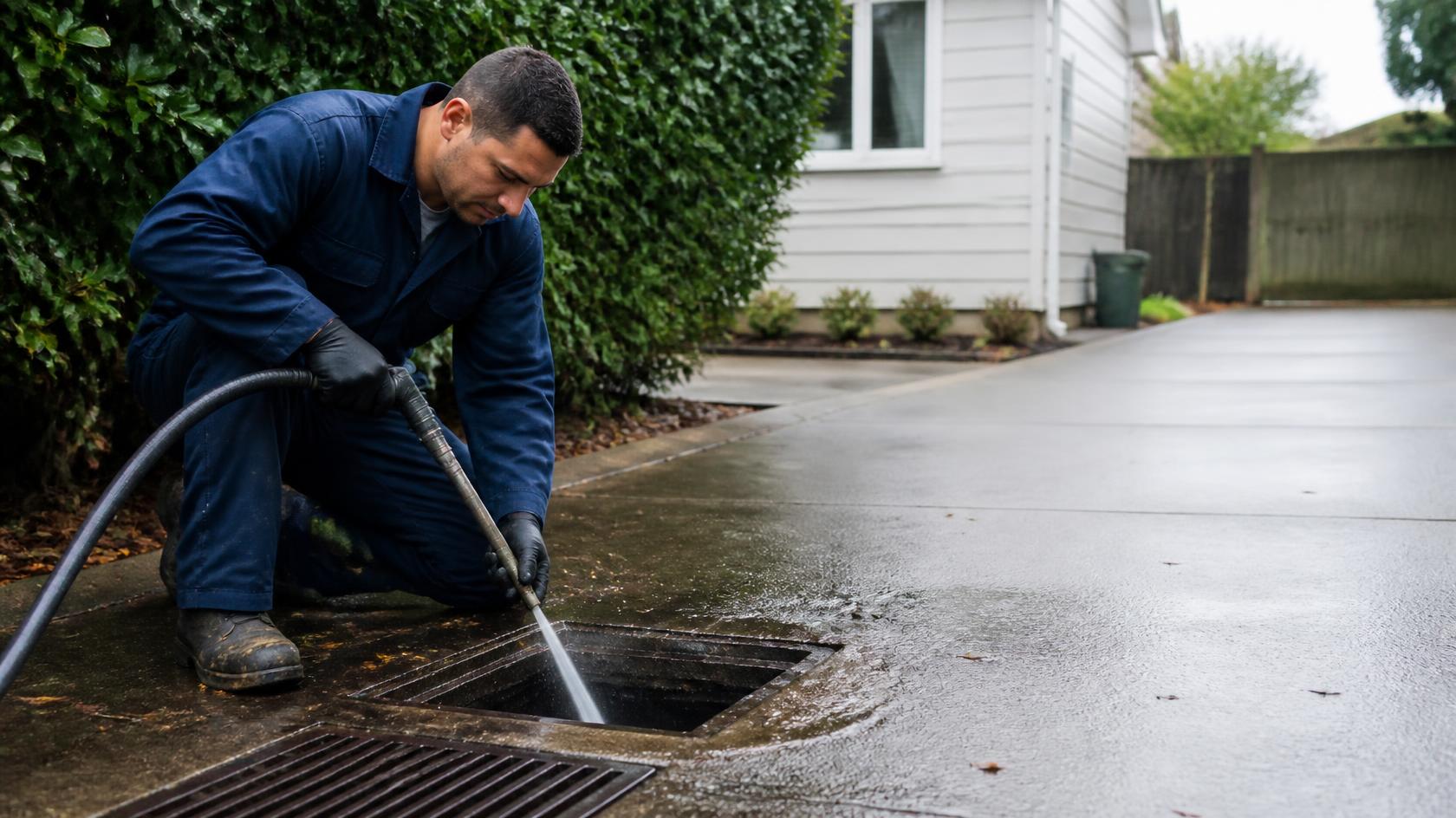
The lower parts of Onehunga sit close to the Manukau Harbour, and private stormwater drainage there works considerably harder than it does on higher ground. Lines and sumps silt up gradually and without symptoms, then fail on the first serious downpour of the season. On a low-lying section that is not an inconvenience, it is water going somewhere it should not.
Local conditions
Earthenware into concrete into uPVC, spliced across decades of alterations. Each fails and repairs differently.
Common through the mid-century housing. Safe undisturbed, brittle when worked, and best identified before an excavation starts.
Silted private lines near the harbour that hold up fine until the storm they were actually needed for.
We cover Onehunga and the surrounding area — Onehunga itself, Te Papapa, Penrose's residential fringe, Royal Oak, Hillsborough and One Tree Hill.
Where a property backs onto the industrial areas or sits on the lower streets near the foreshore, it is worth mentioning when you call. Both change what we expect to find and, in the low-lying case, how urgent a stormwater problem actually is.
An Onehunga blockage affecting only your property is on the private lateral and is the owner's responsibility. If wastewater is surfacing in the street as well, ring Watercare on (09) 442 2222, option 1 — that one is theirs, not yours. Full guide to who pays for what.
Because sections have been replaced at different times over many decades — a repair here, an alteration there, a renovation that relocated a bathroom. It is very common in suburbs with a long, mixed development history. It matters because material determines both the failure mode and the repair options, which is why a proper camera survey records materials as well as faults.
In the lower-lying parts near the harbour, distinctly so. Private stormwater lines, sumps and downpipes are the property owner's responsibility, and they silt up quietly over months before failing during heavy rain. The public stormwater network is Auckland Council's. On a low section, getting the private side cleared before winter is worth considerably more than dealing with it during a storm.
Not on its own account. Undisturbed asbestos-cement pipe in serviceable condition presents no risk and replacing it pre-emptively is money spent for no drainage benefit. Where it is already failing and coming out anyway, that is a different conversation — and one where the handling requirements need to be in the quote from the start.
Sometimes, but the transitions are exactly where it gets complicated. A liner needs a reasonably consistent, round host pipe, and joins between materials are often where the deformation and steps are. This is precisely the situation where a survey before quoting matters — the answer depends on what the camera shows at the junctions, not on the general rule.
If the house has been altered over the years, what is under it probably has been too. A camera pass tells you what you are actually dealing with.