Cleaned, not just opened
Drain Jetting Auckland
Rodding makes a hole through a blockage. Jetting takes the pipe wall back to bare and washes the debris out of the line entirely.
Cleaned, not just opened
Rodding makes a hole through a blockage. Jetting takes the pipe wall back to bare and washes the debris out of the line entirely.
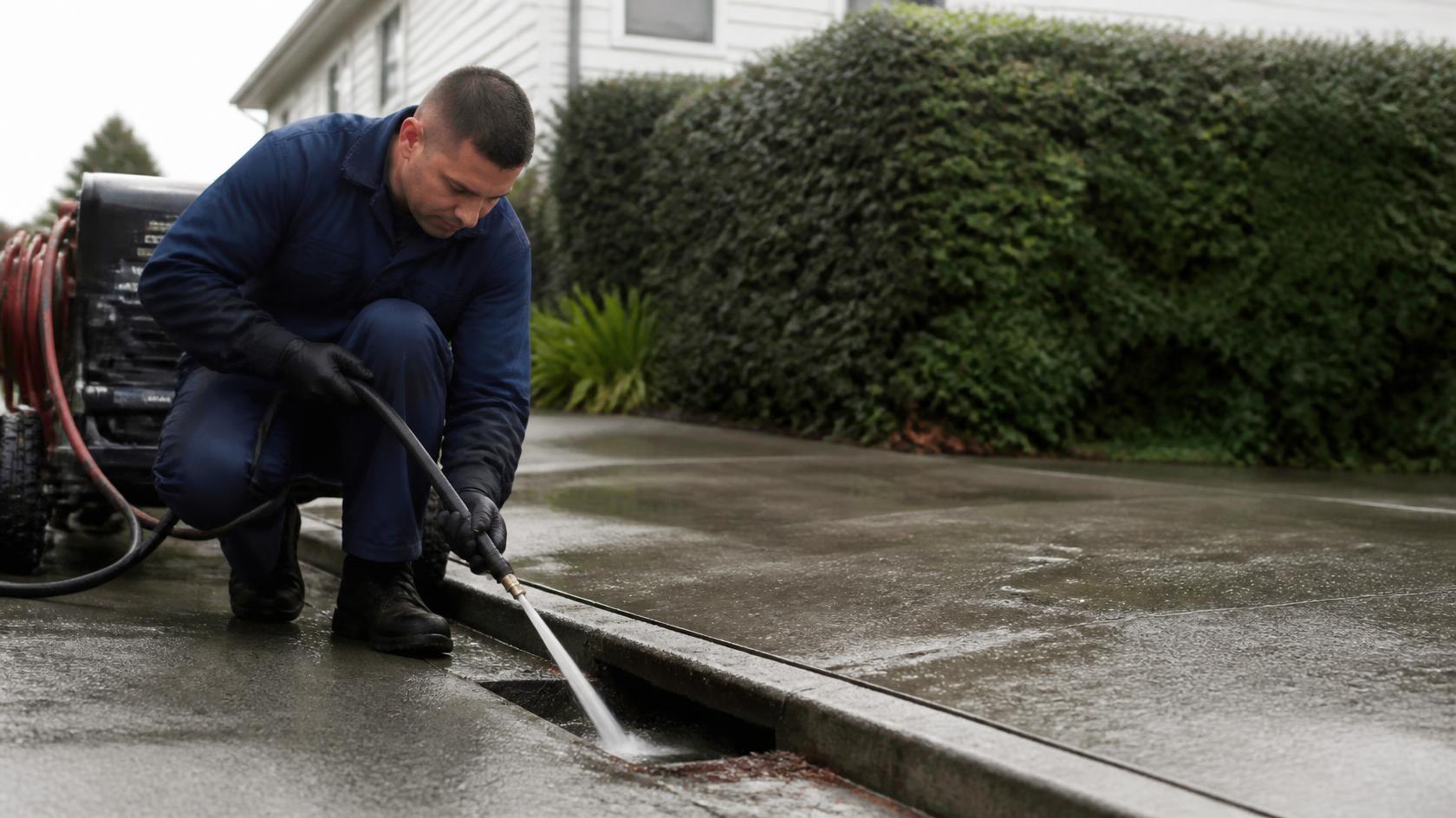
Hydro-jetting cleans a drain using water delivered at high pressure through a specialised nozzle that drives itself along the pipe while firing jets backwards against the wall. Unlike rodding, which punches an opening through the middle of a blockage, jetting scours the full internal circumference and flushes the debris downstream, restoring the pipe's original bore. It is the right method for congealed fat, silt, scale and fine root masses, and it is what commercial kitchen drainage generally needs on a maintenance cycle.
This distinction is worth understanding because it explains why a drain that was "cleared" last month is slow again.
Rodding pushes a flexible rod through the obstruction. Water starts running, everyone declares victory. But what has actually happened is that a channel has been opened through the middle of the blockage. The fat, silt or root material lining the pipe wall is still there, and the bore is still narrowed. It takes very little to close that channel again.
Jetting works differently. The nozzle is drawn along by rearward-facing jets, and those jets scour the pipe wall as they travel, lifting deposits off the surface and carrying them downstream and out of the line. What you get back is close to the pipe's original internal diameter, not a tunnel through a blockage.
It is not always. For a one-off soft blockage in a domestic line, rodding is faster and cheaper and there is no reason to spend more. Jetting earns its cost when the problem is accumulation rather than obstruction — when the pipe has been narrowing steadily and you want the bore back.
Pressure is a tool, not a solution, and in the wrong pipe it is a liability. Old earthenware, degraded asbestos-cement and pipe that a camera shows to be cracked or partially collapsed can be made worse by jetting. This is why we assess condition before reaching for the jetter, and why on any drain with a history we would rather run a camera first. A drainlayer who jets everything by default is not paying attention.
When it applies
Jetting is the answer to build-up. These are the jobs where it clearly beats rodding.
The classic kitchen line problem. Fat goes down warm, cools on the pipe wall and hardens. Rods bore through it; jetting takes it off the wall and out.
High-volume food service lines accumulate fast. Scheduled jetting on a maintenance cycle is dramatically cheaper than emergency callouts and a closed kitchen. The same build-up affects kitchen sinks and grease lines in homes and cafes.
Fine sediment that settles along the invert of the pipe, especially in flat sections and in stormwater lines. Rods pass straight through it without lifting it.
Jetting with a root-cutting nozzle clears fibrous root growth thoroughly. It does not fix the crack the roots came through — see root removal for that.
Leaf litter, silt and grit build up in private stormwater drainage, sumps and cesspits, particularly after autumn and after a dry spell breaks.
A pipe has to be genuinely clean before a liner goes in, or the resin will not bond properly. Jetting is standard preparation for relining.
How it runs
We establish what the pipe is made of and what shape it is in. On any drain with a blockage history, that usually means a camera before the jetter.
The jetting hose is fed in from the gully trap or an inspection point. Pressure and nozzle are chosen for the pipe material, diameter and the type of deposit.
The nozzle travels the pipe, scouring the wall as it goes, and debris is flushed downstream and removed from the system rather than pushed further along it.
Where it matters, a camera pass afterwards confirms the pipe is genuinely clean and shows whether the wall underneath is sound — which is often the more valuable finding.
Cost
| What drives the price | Why it matters |
|---|---|
| Time on the job | Jetting is priced largely by how long the unit is running. A short domestic line is quick; a heavily fouled commercial kitchen run can take hours. |
| Pipe diameter and length | Larger diameters and longer runs need more passes and more water. |
| Type of deposit | Soft silt lifts easily. Hardened fat, scale and compacted root fibre take considerably longer. |
| Access for the unit | Jetting units are truck or trailer mounted. Where the truck can park near the access point, the job is straightforward; long hose runs and awkward sites add time. |
| Whether a camera pass is included | Most jetting jobs are worth verifying afterwards, particularly on older pipe where the condition of the wall underneath is the real question. |
For commercial kitchens and high-use buildings, scheduled jetting on a planned cycle is one of the few genuinely cost-effective preventative measures in drainage. The comparison is not jetting versus doing nothing — it is jetting versus an emergency callout during service, with the kitchen shut. We are happy to work out a sensible interval based on what the line actually looks like.
For realistic dollar ranges across every drainage service, see our Auckland blocked drain cost guide. We give you a price before work starts, never after.
Drain jetting costs more than clearing a drain with rods, and more than the average cost to unclog a drain that only has a single soft blockage. It uses specialist high-pressure equipment and takes longer on site, because the job is to clean the whole pipe wall, not just open a hole through the blockage. The trade-off is that a jetted drain usually stays clear for much longer, which matters most on a line that keeps blocking with fat, silt or fine roots.
What moves the price of a jetting job:
You get the price before the jetter is set up.
Jetting is not always the right answer. If the pipe is cracked, collapsed or has dropped out of line, jetting will clean it but not fix it, and the blockage will come back. In that case we show you the footage and talk through repair or relining instead.
Two Auckland-specific patterns drive most of our jetting work.
Commercial food service. Kitchen drainage through Newmarket, Ponsonby and the city fringe accumulates fat fast, and a lot of it runs through older buildings with narrow, jointed pipework that was never designed for a commercial kitchen. Reactive callouts in that context are expensive in ways that go well beyond the invoice.
Root fibre in older residential lines. Through Mt Eden, Epsom, Remuera and the older parts of the North Shore, jetting with a cutting nozzle clears root growth far more completely than rods. But it is worth being clear that this is treatment, not cure. The roots came in through a failed joint or a crack, and unless that is dealt with they return — usually within a year or two. A camera pass after jetting is what tells you whether you are looking at a maintenance cycle or a repair.
On stormwater, private lines and sumps silt up steadily and then fail at the worst moment — in the first heavy downpour after a dry spell. Auckland Council maintains the public stormwater network and its overland flow paths, but the private stormwater drainage on your property is yours to keep clear.
In sound pipe, no — pressure and nozzle are matched to the material and diameter. In pipe that is already failing, it can. Degraded earthenware, deteriorating asbestos-cement and pipe with existing cracks or partial collapse are genuine risks. That is exactly why we assess condition before jetting and, on any drain with a history, would rather camera it first.
For build-up, clearly yes. Rodding opens a channel through a blockage; jetting removes the deposit from the pipe wall and restores the bore. For a simple one-off soft blockage, rodding is faster and cheaper and there is no reason to pay for jetting.
It depends entirely on volume and what goes down the line. A busy commercial kitchen may need it two to four times a year; a low-use line may go years. The sensible approach is to jet, camera the result, and set the interval from what the pipe actually looks like rather than a generic schedule.
No. It clears them thoroughly, which is more than rods achieve, but roots return through the same entry point because that is where the moisture is. Permanent resolution means sealing or replacing the section they come through — see tree root removal and relining.
With assessment first, yes. Plenty of Auckland's pre-1960s earthenware is jetted routinely without issue. The cases needing caution are pipe already cracked, crushed or badly degraded — and the honest position is that the camera should decide, not the equipment on the truck.
For a single slow basin or shower, the cheapest way is a plunger, a plastic hair-removal strip, or lifting out the grate and clearing what is caught under it. Those cost little or nothing; removing the trap itself is restricted plumbing work. Jetting sits at the other end of the scale. Once the outside gully overflows or the drain keeps blocking, DIY stops being cheap: hired rods can jam or break old pipe. Our guide to how to unblock a drain covers the low-cost options.
A jetting unit uses a substantial volume during operation. The water and the debris it carries discharge into the drainage system downstream, which is where they were headed anyway — the point is that the deposit leaves your pipe rather than sitting further along it.
We cover the whole region. Pick your suburb for local detail.
Tell us what the drain is doing. We will tell you whether this is the service you need, and what it should cost.