Cleared, and explained
Drain Unblocking Auckland
Slow, gurgling, backing up or overflowing. We clear it, then tell you whether it was a one-off or a pipe that is going to keep doing this.
Cleared, and explained
Slow, gurgling, backing up or overflowing. We clear it, then tell you whether it was a one-off or a pipe that is going to keep doing this.
Drain unblocking is the clearing of an obstruction from a wastewater or stormwater line so normal flow returns. In Auckland it is done by rodding, by a powered drain machine, or by high-pressure water jetting, chosen according to what is blocking the pipe and what condition the pipe is in. Most straightforward residential blockages are cleared from the outside gully trap in a single visit. Where a drain has blocked before, clearing alone is not the answer — the cause needs identifying with a camera.
We unblock drains across the whole Auckland region: North Shore, West, Central, East and South Auckland. We are a mobile service, so the van comes to you, 24 hours a day, 7 days a week. Every job starts with a price agreed before any work starts, and ends with an explanation of what caused the blockage. If you want local detail, there is a page for each suburb we cover on our service areas page.
It depends on which stormwater drain is blocked, because Auckland's stormwater has two owners.
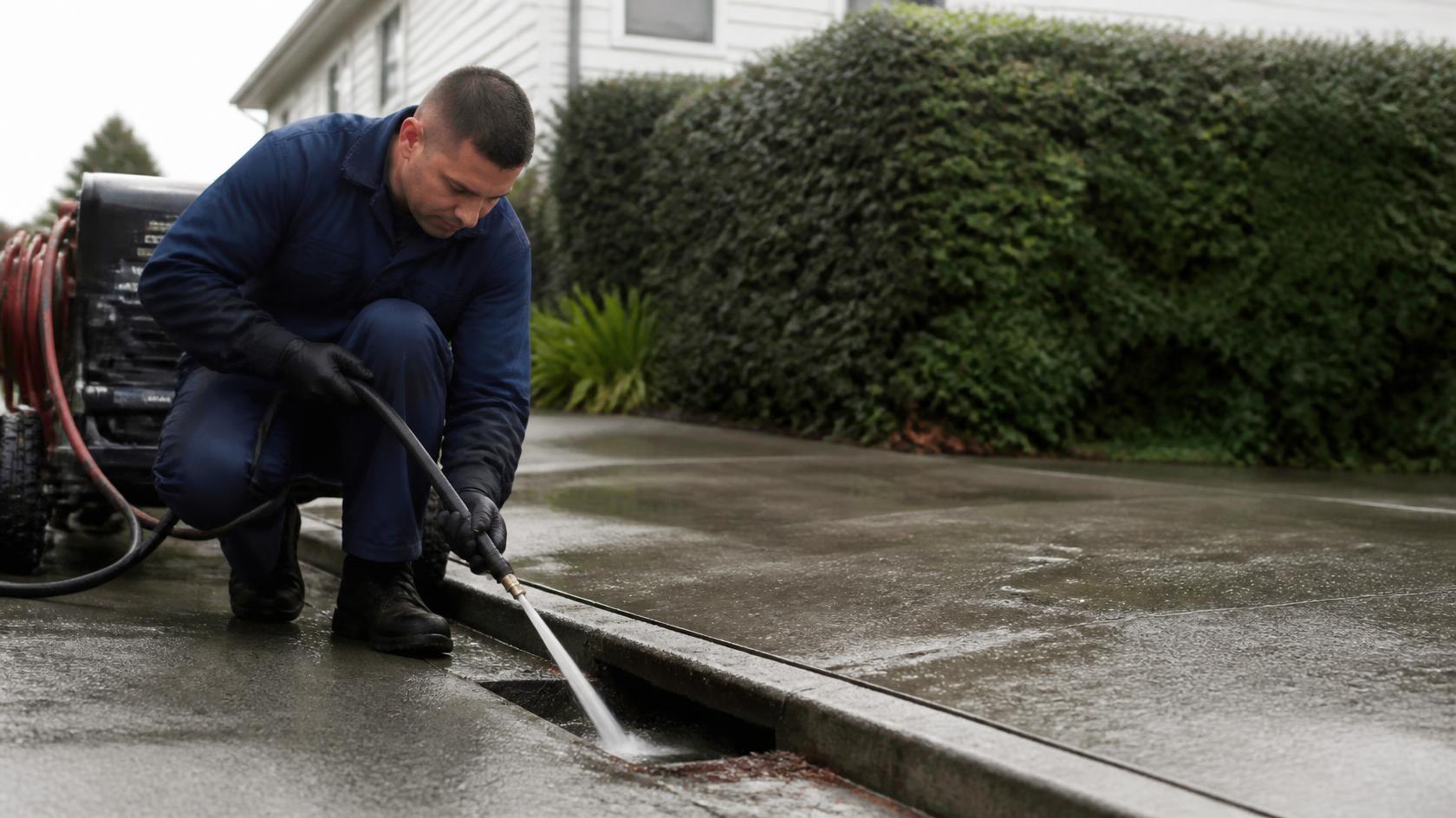
Your private stormwater is yours. That covers your downpipes, the stormwater lines across your section, and any sumps, cesspits or channel drains on your property. We clear these the same way as any other drain, and we can put a camera down the line if it keeps blocking or overflowing in heavy rain.
Public stormwater belongs to Auckland Council. Public stormwater pipes and the catchpits in the street are looked after by the council's Healthy Waters team. If a street catchpit is blocked or the water is backing up from the public network, report it to Auckland Council rather than paying a private contractor.
Wastewater and stormwater are separate systems. Stormwater carries rain from roofs and hard surfaces. Wastewater carries what leaves your toilets, sinks and showers. A camera survey sometimes finds a stormwater line illegally connected into the wastewater line, which is a common cause of overflows in heavy rain and something the owner is responsible for fixing. If you are not sure which of your drains is which, we can find out.
There are really two problems whenever a drain blocks. The first is what is in the pipe right now. The second is why it got there. Most callouts only deal with the first, which is why so many Auckland households are on their third or fourth drain clear at the same address.
If your drain has never blocked before, the first question is usually the only one that matters. Something went down that should not have, it caught, and once it is gone the drain is fine. If it has blocked before — especially in the same spot, or at the same time each year — something physical is in that pipe, and clearing it is a temporary measure, not a repair.
We will tell you which situation you are in, and we would rather tell you before you pay for the fourth clear than after.
Two things worth checking, because they change the diagnosis considerably:
If wastewater is also surfacing in the street, or your neighbours have the same problem on the same day, the public wastewater main may be blocked rather than your private lateral. That is Watercare's to clear, at no cost to you, and they explicitly ask you to call them before you call a plumber in that situation. Their 24/7 faults line is (09) 442 2222, option 1. Our full guide to who is responsible for which drain covers where the boundary sits.
When it applies
Blockages turn up in predictable places. These are the ones we are called to most across Auckland.
A toilet that fills and drains slowly, or will not clear at all. Often wipes, sanitary products or an object, but if other fixtures are affected too the problem is further down the line. Our page on blocked toilets explains how to tell which.
Congealed cooking fat is the classic. It goes down warm and liquid, cools on the pipe wall, and narrows the line over months until something finally catches on it. A slow blocked kitchen sink is often the first sign.
Wastewater rising in the outside gully means the blockage is downstream of the house. Unpleasant, but far better than it backing up inside.
Usually hair and soap in the fixture's own trap or waste pipe. Quick to clear, and rarely a sign of anything deeper if it is only that one fixture. Our blocked shower drain guide covers what you can clear yourself.
Same drain, same spot, every few months. This is not a clearing problem, it is a pipe problem, and a camera survey is what tells you which one.
High-use kitchens, multi-tenant buildings and rentals where nobody is quite sure what has gone down the line. Often better handled with scheduled jetting than repeat emergency callouts.
How it runs
Which fixtures, whether the gully is overflowing, whether it has happened before. That alone narrows the likely cause and tells us what gear to load.
A realistic range on the phone, a firm price on site before anything starts. No work begins on a number you have not approved.
Usually from the gully trap or an inspection point. Rods for soft blockages, a drain machine for firmer ones, the jetter where the pipe wall needs scouring rather than punching through.
Where the drain has blocked before, or the blockage looks unusual, we put a camera down and show you what is actually there before recommending anything further.
Cost
For a straightforward blockage cleared from the outside gully trap in business hours, a drain unblocking service in Auckland usually costs a few hundred dollars. Jetting, a CCTV inspection or an after-hours emergency service adds to that. How much you pay comes down to the five things below, not the suburb, and you get the price before anyone starts.
| What drives the price | Why it matters |
|---|---|
| Access | A clear, reachable outside gully trap is the cheapest scenario. A blockage that can only be reached through an inspection point under decking, inside a locked garage or beneath a garden bed takes longer. |
| Method needed | Rodding is quickest. A powered drain machine costs more. Hydro-jetting costs more again, because it is a truck-mounted unit and a different skill set. |
| What is blocking it | Soft blockages clear fast. Compacted fat, a root mass or a foreign object can take hours. |
| Pipe condition | A sound modern uPVC line is straightforward. Brittle earthenware or asbestos-cement pipe has to be worked far more carefully, which takes longer. |
| Time of day | After-hours and public holiday emergency callouts carry a higher rate than a booked weekday visit. |
Nobody can give you a guaranteed fixed price for clearing a drain sight unseen, and you should be a little wary of anyone who does. What you should get — and what we give you — is a realistic range up front, and a firm price on site before work starts. If what we find changes the job, we stop and re-quote rather than letting the invoice grow.
For realistic dollar ranges across every drainage service, see our Auckland blocked drain cost guide. We give you a price before work starts, never after.
Blockages are not random. Across Auckland they follow the age of the pipe and what is growing above it.
Pre-1960s housing — the villas and bungalows through Ponsonby, Grey Lynn, Mt Eden, Epsom, Remuera and Ponsonby — was drained with short lengths of glazed earthenware or concrete pipe, joined roughly every 600mm and sealed with mortar. Those joints are where everything goes wrong. Once one opens up, roots find it and silt collects.
1960s to 1980s housing brought concrete and asbestos-cement drainage. Asbestos-cement pipe is still in the ground across a lot of Auckland. It is safe while undisturbed but brittle, and it changes how a repair has to be approached — worth knowing before anyone starts digging.
Post-1980s uPVC uses long runs with rubber-ring joints, so root intrusion is far less common. When newer drains block, it is nearly always the contents rather than the pipe: fat, wipes, food waste, or a run laid too flat that now holds water. Newer subdivisions like Botany Downs and much of Albany sit in this category.
Layer on Auckland's clay soils, which swell and shrink with the seasons and slowly pull jointed pipe out of alignment, plus liquidambar, plane and willow roots working along every damp joint, and you have the two faults we see more than any others: root intrusion and displaced joints.
Drainage in New Zealand has to comply with the Building Code — Clause G13 covers foul water disposal, and Clause E1 covers surface water. Installing, altering or repairing a drain is restricted work that must be done or supervised by someone licensed by the Plumbers, Gasfitters and Drainlayers Board. Clearing a blockage is not restricted — you may legally do that yourself, provided you do not alter or repair the inspection or ventilation pipe.
Most straightforward residential blockages are cleared within an hour of arriving. A heavy root mass, a compacted fat blockage in a commercial line, or a blockage that is difficult to reach can take several hours. If it becomes clear the drain cannot be cleared at all — because it has collapsed — we stop and tell you rather than charging you for more hours of trying.
Legally, yes. The PGDB permits a homeowner to clear a blocked drain, provided the work does not involve altering or repairing the inspection pipe or ventilation pipe. Practically it depends. A hair clog in a basin waste, cleared with a plunger or through the cleaning cap of a bottle trap, is a reasonable DIY job; removing the trap itself is restricted plumbing work. A blocked main lateral generally is not: hired rods can snap or become stuck, wastewater is a genuine biological hazard, and forcing equipment through brittle earthenware can turn a blockage into a broken pipe.
Rarely, and it can make things worse. Caustic cleaners may shift a soft soap or hair clog in a basin waste, but they do nothing against roots or a collapsed pipe. In a fully blocked line they simply sit in the standing water, making the job hazardous for whoever opens it up. If the drain is fully blocked, skip the chemicals and save the money. Our guide on whether drain cleaners work compares each type.
Hot water can help a slow kitchen sink where fat is only starting to set, but boiling water is a poor tool. It can soften plastic waste pipe, loosen joints and crack a porcelain toilet bowl, and it does nothing for wipes, roots or a dropped pipe. Hot tap water and a plunger are safer. The same goes for pouring salt down the drain every night: harmless, but it does not dissolve fat or hair. Our guide on how to unblock a drain covers what actually works.
Because the clearing removed the blockage but not the reason it formed. Roots regrow through the same joint. A dropped section keeps collecting solids. A rough or cracked pipe wall keeps catching fat. If a drain has blocked more than once, a CCTV survey is the cheapest way to stop paying for the same visit repeatedly.
Yes, private stormwater lines on your property. Blocked stormwater usually means leaves and silt in downpipes, sumps or the private line. The public stormwater network is a separate system managed by Auckland Council’s Healthy Waters team — if the problem is a blocked public catchpit in the street rather than your own pipe, that is theirs. Our page on stormwater and outside drains covers sumps, gully traps and who owns which pipe.
Then the drain almost certainly has a physical fault — a collapse, a severe displacement, or a crush. We will show you on camera what we are looking at and talk through the repair options. You are not charged for clearing that could not be achieved.
Yes. Emergency drainage callout runs 24 hours, 7 days including public holidays. If wastewater is actively escaping, that is an emergency and worth calling about immediately rather than waiting for morning.
We cover the whole region. Pick your suburb for local detail.
Tell us what the drain is doing. We will tell you whether this is the service you need, and what it should cost.