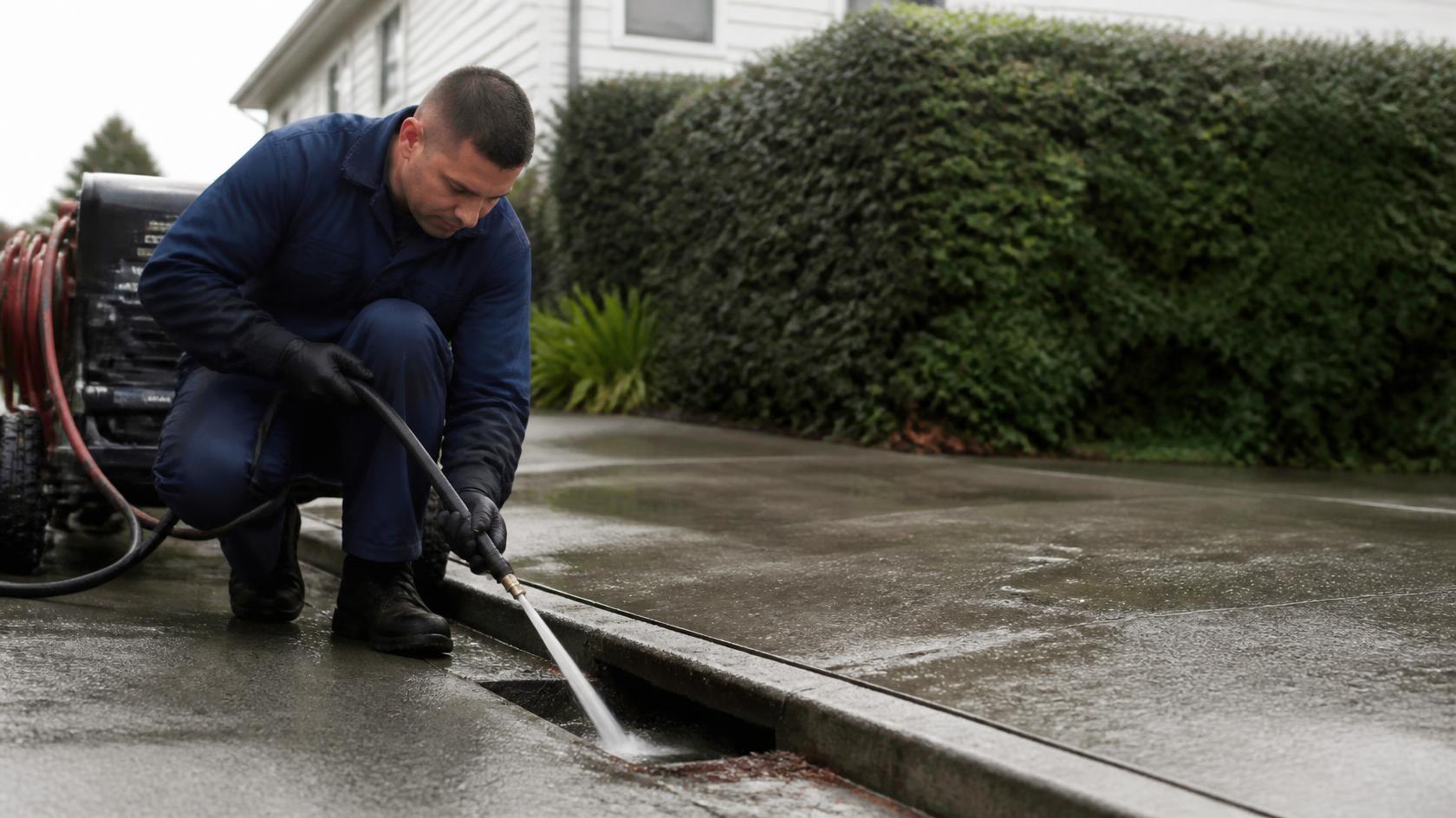
A septic tank needs its sludge and scum pumped out before they fill about half the tank. In Auckland that is a rule, not just advice: Auckland Council requires a basic septic tank to be inspected at least every three years and pumped out once it reaches that level, and an aerated system to be serviced every six months. We arrange a septic service contractor with a vacuum tanker to pump out, check and record your system. What it should cost is in our septic tank cleaning cost guide.
Which parts of Auckland are on septic tanks?
Most of urban Auckland is connected to Watercare's wastewater network. Properties outside it treat their own
wastewater on site, and Auckland Council puts the number of private onsite systems at around 45,000. They are
mainly rural properties and the Hauraki Gulf islands: lifestyle blocks and farms across Rodney and Franklin,
the Waitākere Ranges, and rural fringes in the north and south.
In practice that means places like the rural roads around Warkworth, Kumeū and Helensville, the
Waitākere Ranges settlements such as Piha, Waiheke and the other gulf islands, and the countryside around
Pukekohe, Waiuku and the south. The town centres themselves are mostly on Watercare's network. If you are
not sure, check your bills: a property connected to the public network usually pays Watercare for wastewater.
If yours does not, you almost certainly have an onsite system, and the
council's onsite wastewater page sets out what that means.
How does a septic tank work?
A septic tank is a watertight tank, usually buried, that every drain in the house runs into. Wastewater
sits in it long enough to separate into three layers: scum that floats, a middle layer of liquid, and sludge
that settles on the floor. Bacteria break some of the solids down. The liquid flows out to the disposal
field, where the soil finishes the treatment.
The sludge and scum do not leave. Bacteria shrink them, but sand, grit and the parts of the waste nothing
can digest build up over the years, and that is why every tank needs pumping out. A septic tank is a
primary treatment system, the simplest kind. Many have an outlet filter fitted to stop solids
escaping to the field. Auckland's rules call for one in several situations, and the council recommends fitting one. Because the field
depends on soakage, soil type matters: clay and high groundwater both slow it down.
How often should a septic tank be pumped out in Auckland?
Auckland's rule is about inspection first. Under the Auckland Unitary Plan, a basic septic tank and its
disposal field must be inspected at least every three years, and pumped out when sludge and scum take up half
the tank's volume. Council booklets advise planning on a pump-out about every three years. National guidance
puts most household tanks at every three to five years.
Where your tank falls in that range comes down to its size, how many people live in the house, how much
water you use and what goes into it. A kitchen waste disposal unit adds solids and shortens the interval. A
holiday home used a few weeks a year can go longer, which is exactly why the rule is to measure, not guess.
The contractor measures both layers at each visit and tells you when the next pump-out should be.
Inspected every three years, emptied when it is due
You will see it said that
Auckland Council requires every septic tank to be emptied every three years. The
Unitary Plan rule (E5.6.1) is an inspection at least every three years, and a
pump-out where the inspection finds sludge and scum at half the tank. In practice many tanks are due by
then, so the two are often done together.
Signs your septic tank is due for a pump-out
A tank that needs pumping usually gives warnings before it overflows. Drains throughout the house slow
down together, toilets gurgle, and there is a sewage smell near the tank lids or over the disposal field.
Outside, look for wet, boggy or unusually lush green patches over the field, or murky water pooling on the
surface. Any of these is worth a call before it becomes an overflow.
- Every drain slow at once. One slow basin is a local blockage. Toilet, shower and sinks all
slowing together points to the tank, its outlet filter or the field.
- Gurgling. Air being pushed back through the pipes as water struggles to get out.
- Smells. A sewage smell around the tank, the field or the gully trap. A strong smell with no
other sign can also mean the tank's bacteria have been killed off by chemicals.
- A wet or green disposal field. Soggy ground, ponding, or grass noticeably greener than the
rest of the lawn over the field. The council's own advice is that a boggy, smelly or overgrown field may mean a
leak that needs repairing.
- Overflow at the gully trap. Wastewater coming up outside the house is the late stage.
- A council letter. If the Safe Septic Programme has asked for your maintenance records and you
do not have a recent inspection, you are due one.
Slow drains on a septic property are not always the tank. The pipe between the house and the tank can block
like any other drain, and that is a drain unblocking job, not a pump-out. The
general signs of a blocked drain help tell the two apart.
| What you notice | Likely cause | What it usually needs |
|---|
| One fixture slow, the rest fine | A blockage in that fixture's waste or trap | Clear that fixture first |
| Everything slow, tank not pumped for years | Tank full or outlet filter clogged | Pump-out and filter clean |
| Everything slow, tank recently pumped | Blocked drain between the house and the tank | Drain clearing |
| Boggy, smelly ground over the field | Field overloaded or clogged with solids | Inspection of tank and field |
| Smell but no other sign | Bacteria killed off, or a lid or vent problem | Inspection |
Auckland Council's rules for septic tanks
As the property owner, you are responsible for maintaining your onsite system. The Unitary Plan requires
it to be maintained by a suitably qualified onsite wastewater service provider, with a basic septic tank
inspected at least every three years, aerated systems serviced six-monthly, outlet filters serviced at the
manufacturer's intervals, and records of every visit kept for the council to see.
Auckland Council checks this through its Safe Septic Programme, which asks
owners for proof of maintenance. The council says failing to maintain a system can lead to a fine, and that
you can be fined for each day a faulty system is used. It keeps a list of service providers that send its
standard servicing form straight to the council on your behalf. You can report a neighbourhood wastewater
nuisance, such as a smell or seepage, to the council on 09 301 0101.
The rules also protect the disposal field. There must be no heavy vehicle or stock access over it, any reserve
disposal area must be kept usable, and the discharge must not reach groundwater, streams, a stormwater drain or
a neighbouring property. If you extend the house, add people or turn a bach into a permanent home, the
council advises reviewing the system, and an upgrade needs a building consent and possibly a resource consent.
Waitākere Rural Sewerage Scheme ends in 2027
The council has pumped
out septic tanks about every three years for eligible properties in the former Waitākere area, paid for by a
targeted rate. According to the council's scheme notice, the scheme and its rate
end on 30 June 2027. From 1 July 2027 owners there arrange and pay for their own pump-outs, and the council
will no longer schedule them or remind owners when one is due. The Safe Septic Programme carries on.
Aerated systems and a basic septic tank: what is different?
An aerated or other secondary treatment system goes further than a septic tank. It has several chambers,
usually with an air blower and pumps, so oxygen-loving bacteria can treat the wastewater to a higher standard.
The cleaner effluent is often filtered and spread through drip lines near the surface. It needs servicing
every six months, so most owners keep a maintenance contract.
A six-monthly service checks the filters, pumps, blower, alarm and drip lines, and measures sludge. Aerated
systems still collect sludge and still need it pumped out every few years, so a service contract and a
pump-out are two different jobs. Some manufacturers make regular servicing a condition of the warranty, and the
council suggests using a provider approved by your system's manufacturer. If your system has a pump, a blower
or an alarm light, treat it as a secondary system, not a plain septic tank.
Looking after the disposal field
The disposal field is where the system actually finishes treating your wastewater, and it is usually the most
expensive part to put right. Keep cars, trucks and stock off it, plant only small, shallow-rooted plants on it,
and keep stormwater and roof water away from it. If parts of it are boggy, smelly or overgrown, have it
checked before it fails completely.
Most field failures start in the tank. When a tank is left too long, sludge and scum reach the outlet and
solids are carried into the field, where they clog the soil. An outlet filter is the cheap protection against
that, as long as it is cleaned. Roof water piped into the tank, or a downpipe discharging onto the field, can
flood the whole system in winter. Some systems have a distribution box so that parts of the field can be rested
in turn.
What not to put in a septic tank, and do additives help?
A septic tank depends on bacteria, so anything that kills them, or adds solids they cannot digest, works
against it. Auckland Council's guidance lists harsh chemicals including bleach, antibacterial cleaners, nappy
cleaner, paint, medicines and pesticides, plus oils, fats and grease, food scraps, coffee grounds, wipes,
nappies and sanitary products. Everyday cleaners used sparingly are generally fine.
- Chemicals in quantity. A splash of bleach to clean the toilet is not the problem. Regular heavy
use, or tipping drain cleaner into the system, is. Chemical drain cleaners are covered in
do drain cleaners work.
- Fats and food. Scrape plates into the bin. The council's advice is not to use a kitchen waste
disposal unit on a septic system.
- Wipes and sanitary products. They do not break down in the tank, and they clog outlet filters.
The rest of the list is in what not to put down the drain.
- Too much water at once. Fix leaking taps, run full loads and spread the washing through the
week, so solids have time to settle.
Septic tank additives, sold as tablets, powders or bacterial treatments, are generally unnecessary. A
Washington State University Extension review notes that normal use supplies the bacteria
a tank needs, cites a study of 48 tanks that found no difference in sludge levels with bacterial additives, and
warns that chemical additives can harm the system. No product we know of removes the need to pump.