South Auckland
Blocked Drains Manukau
Manukau is a commercial centre with suburbs around it, and we work across both.
South Auckland
Manukau is a commercial centre with suburbs around it, and we work across both.
Manukau combines a major commercial and civic centre with residential areas of several different eras. The commercial core brings high-volume drainage — retail, food premises, offices and civic buildings — where sustained loading and grease dominate. The surrounding residential streets span decades of development, so the faults range from mid-century displaced joints through to straightforward contents blockages in newer housing.
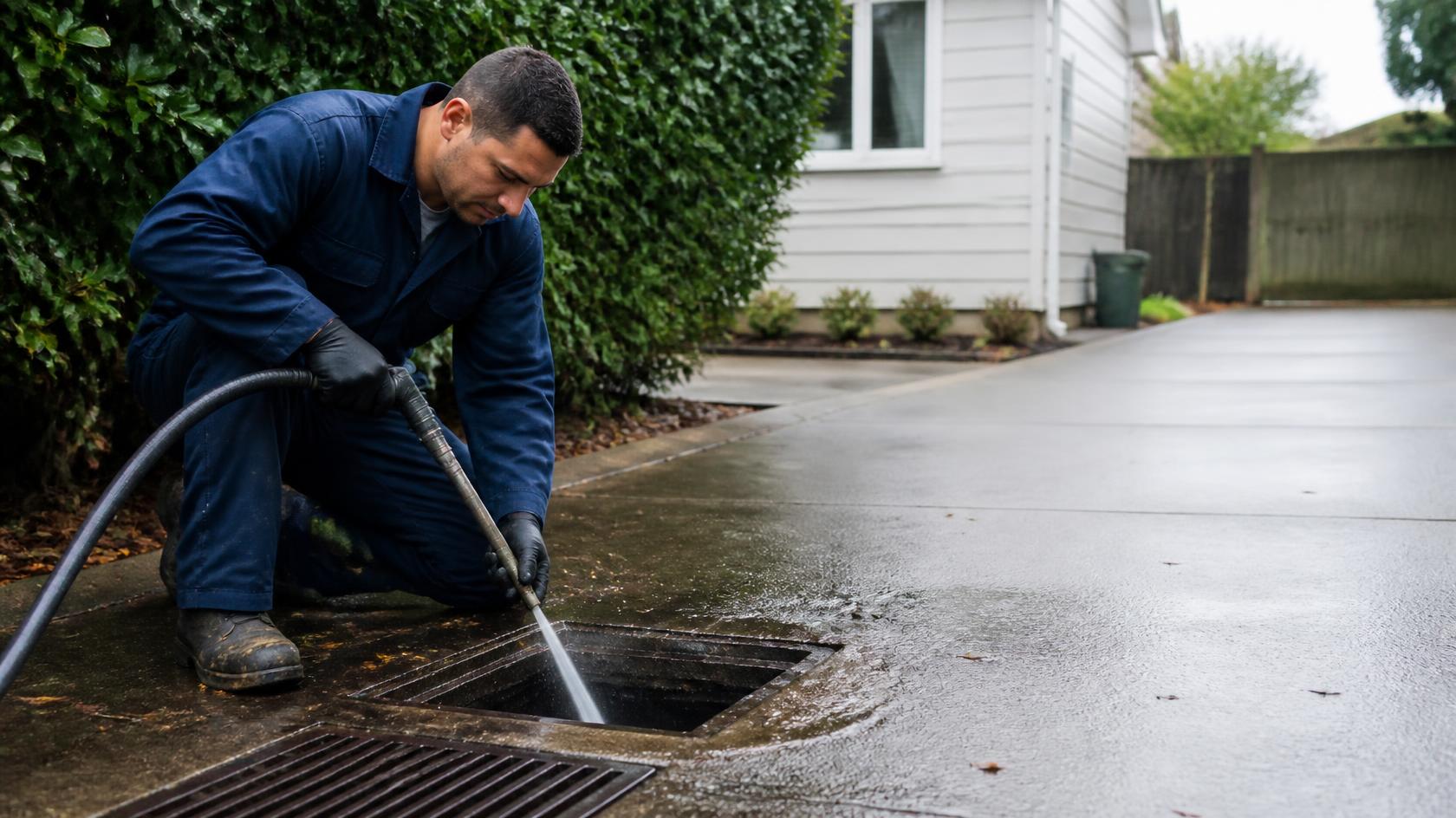
Half our Manukau work is commercial. Retail, hospitality, offices and multi-tenant buildings generate sustained drainage loading, and the sensible model there is almost never reactive. A scheduled jetting interval, set from what a camera actually shows rather than a generic frequency, costs less than emergency attendance during trading hours and avoids the disruption entirely.
The other half is residential, and it looks like the rest of South Auckland: mid-century concrete and asbestos-cement laterals with displaced joints, newer housing with contents blockages, and a growing number of multi-unit developments on shared drainage.
Infill and multi-unit development across Manukau has created a lot of shared private laterals — one drain serving several dwellings before it reaches the public main. This is the source of most of the disputes we see here. A shared private drain is still private, so it is not Watercare's, and the cost is generally apportioned between the owners it serves. Establishing that before there is an invoice is much easier than afterwards.
South Auckland clay moves seasonally like the rest of the region's, and on the older residential streets the consequences are familiar: joints that have stepped or opened, sections holding standing water, and roots taking the opportunity.
Local conditions
Retail, hospitality and civic buildings generating sustained loading. Far better handled on a maintenance interval than reactively.
Concrete and asbestos-cement laterals in the older streets, with the displaced joints typical of the era.
One private lateral serving several dwellings, with responsibility shared and usually undiscussed until something blocks.
We cover Manukau and the surrounding south — Manukau Central, Wiri, Clendon, Weymouth, Māngere East, Ōtara and out towards Papatoetoe and East Tāmaki.
For commercial and civic premises we can generally schedule outside operating hours, which for retail and food premises is usually both cheaper overall and far less disruptive than working through the trading day.
If your Manukau drain is shared with neighbouring dwellings, it remains private — so the cost is shared between owners, not Watercare's. If wastewater is surfacing in the street as well, ring Watercare on (09) 442 2222, option 1 — that one is theirs, not yours. Full guide to who pays for what.
Yes, and it is a significant part of what we do here. Retail, hospitality, offices and multi-tenant buildings all generate sustained drainage loading, and we would generally rather set up a scheduled jetting interval based on what the line looks like on camera than keep attending emergencies during trading hours. It costs less and it avoids the disruption.
A shared private drain remains private, so it is not Watercare's responsibility. Cost is generally shared between the owners the drain serves, with the title or body corporate documents setting out how it splits. CCTV footage showing exactly where the fault sits — and on whose land — is what settles those conversations quickly rather than expensively.
Yes, and for retail and food premises it is usually the better call. Doing the work before opening costs less in total than closing during trade, even at an out-of-hours rate. We would rather schedule around your operation than through it.
It depends entirely on the cause, and that is answerable rather than a matter of opinion. Roots or a failing pipe are a landlord cost; a wad of wipes in an otherwise sound line may be argued differently. A camera survey shows which, and having that evidence at the time is far more useful than reconstructing the argument weeks later.
Commercial or residential, tell us what the drain is doing and whether it has done it before. Both change the answer.