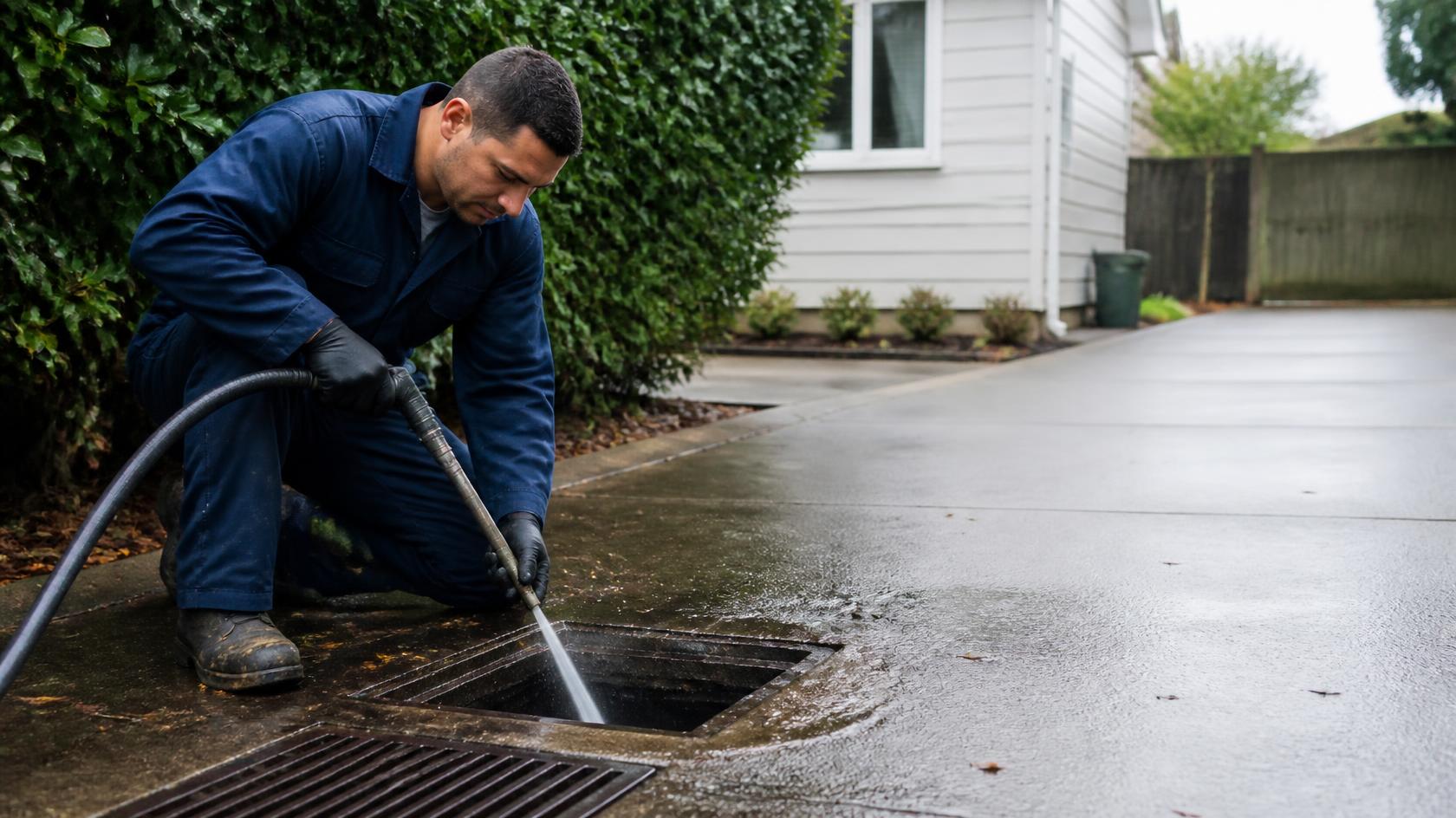
Drainage technician clearing a blocked outside gully trap at an Auckland property

24/7 emergency callout · Auckland-wide

Blocked drains cleared. Causes found.

Anyone can push a blockage through. We clear the drain, put a camera down the line, and tell you whether you have a one-off blockage or a pipe that is going to keep doing this — before you spend money on the wrong fix.

Licensed & certifying drainlayers
24/7 emergency callout, 7 days
Upfront price before work starts
Camera-verified — you see the fault

Start here

First question: is this even your pipe?

In Auckland, everything on your side of the point of supply is the property owner’s responsibility — that is the private wastewater lateral running from your fixtures out to the connection with the public network. The public wastewater main is Watercare’s, and they clear blockages on it at no charge to you. Auckland Council’s Healthy Waters looks after the public stormwater network, which is a separate system with a separate owner.

It is worth thirty seconds of thought, because it decides who pays. Most household blockages do turn out to be on the private lateral. But if wastewater is surfacing in the street as well as your yard, or your neighbours have the same problem on the same day, the main is the more likely culprit — and Watercare explicitly ask you to call them before you call a plumber when that is the case. Their 24/7 faults line is (09) 442 2222, option 1.

We will tell you honestly which side of the line your problem is on. If it is Watercare’s, we say so and you pay us nothing — that is a much better outcome for you than us clearing a private drain that was never the problem.

Read the full guide to drain responsibility

Quick guide to who owns what

WhatWhose
Pipes inside the houseYours
Gully trap outsideYours
Private lateral to the boundaryYours
Shared private drain (multiple homes)Shared between owners
Public wastewater mainWatercare
Public stormwater pipes & catchpitsAuckland Council
Your downpipes & private stormwaterYours

Sources: Watercare and Auckland Council. Where a shared private drain serves several properties, the owners share responsibility for it — a common situation in Auckland cross-lease and infill housing.

What we do

Drainage services across Auckland

From a kitchen sink that will not drain to a collapsed lateral under a driveway. Everything below is done by drainage tradespeople, not general handymen.

Local conditions

Why Auckland drains block the way they do

Drainage problems are not random. In Auckland they follow the age of the pipe, the trees on the street and the ground the pipe sits in — which is why the same suburbs throw up the same faults again and again.

Pre-1960s: earthenware and concrete

Villas and bungalows across Ponsonby, Grey Lynn, Mt Eden, Epsom, Remuera and Devonport were drained with short lengths of glazed earthenware or concrete pipe, joined every 600mm or so and sealed with mortar. Those joints are the weak point. Once one opens up, roots and silt have a way in.

1960s–1980s: mixed materials

Post-war and early suburban housing brought concrete and asbestos-cement drainage. Asbestos-cement pipe is still in the ground in plenty of Auckland properties. It is safe while undisturbed, but it is brittle and it changes how a repair has to be handled — which is worth knowing before anyone starts digging.

Post-1980s: uPVC

Modern uPVC drainage uses long runs and rubber-ring joints, so root intrusion is far less common. When newer drains block it is usually the contents rather than the pipe: fat and food waste, wet wipes, or a fall that was laid too flat and now holds water.

Trees on the street, roots in the drain

Liquidambar, plane, willow and poplar are heavy water-seekers and are common in Auckland’s older streets. Roots do not usually break sound pipe — they find the moisture already escaping from a failing joint and grow to it. That is why cutting roots without finding the entry point buys you a year or two, not a solution.

Clay soils that move

Much of Auckland sits on clay that swells when wet and shrinks when dry. Over decades that movement pulls jointed pipe out of line, creating steps and sags where water and solids sit. It is a slow failure, and it shows up as a drain that gradually starts blocking more often each winter.

Wet weather and overflows

Parts of central Auckland have historically carried wastewater and stormwater in combined lines, which is why heavy rain used to trigger overflows. Watercare’s Central Interceptor tunnel was built to reduce exactly that. On a private property, the equivalent problem is stormwater illegally connected into the wastewater line — something a camera survey will find.
How a job runs

What actually happens when you call us

No mystery, and no invoice that arrives bigger than the conversation.

You describe the symptoms

Which fixtures, whether the outside gully is overflowing, how long it has been happening. That alone narrows the likely cause a long way.

We agree a price first

You get a realistic range on the phone and a firm price on site before anything starts. If what we find changes the job, we stop and re-quote.

We clear it and look

Rods, a machine or the jetter, depending on the blockage. Then, where it matters, a camera down the line to see what caused it.

You get the findings

Plain-language explanation, footage where we ran a camera, and an honest view on whether this needs repairing or just watching.

Where we work

Drain unblocking across the Auckland region

We are a mobile service — the van comes to the property. Pick your suburb for local detail on what tends to go wrong there.

North Shore

West Auckland

Central Auckland

East Auckland

South Auckland

See all service areas

Why us

What we do differently

We find the cause, not just the blockage

Clearing a drain and driving away is the easy version of this job. If your drain has blocked before, we want to know why, and we will put a camera down to find out rather than guessing.

You see what we see

Camera footage and stills are yours to keep. That matters if you are a landlord justifying a repair, a buyer deciding on a property, or an owner getting a second quote.

We tell you when to do nothing

Not every fault found on camera needs fixing now. A minor root at a joint on a drain that has never blocked is worth monitoring, not excavating. We will say so.

We tell you when it is not ours to fix

If the fault is on the public main, that is Watercare’s to repair at no cost to you, and we will point you there instead of clearing a private drain that was never blocked.

Price before work, not after

You approve a number before anyone starts. If the scope changes because of what is in the ground, we stop, show you and re-quote.

Licensed for restricted work

Drain repair and alteration is restricted work under New Zealand law. It is done or supervised by licensed people, and you are welcome to ask for the licence card and check it on the PGDB register.

Questions

Blocked drains in Auckland — straight answers

Who is responsible for a blocked drain in Auckland — me or Watercare?

It depends which side of the point of supply the blockage is on. Everything on your side — the private wastewater lateral running from your fixtures out to the connection with the public network — is the property owner’s to maintain and pay for. The public wastewater main itself is Watercare’s, and they attend blockages on it at no cost to you.

In practice the great majority of household blockages are on the private lateral. But if wastewater is also surfacing in the street, or several neighbours have the same problem at once, that points to the public main. Watercare specifically ask you to call them before you call a plumber in that situation. Their 24/7 faults line is (09) 442 2222, option 1. Their guide to who is responsible for which pipes sets the boundary out with diagrams.

What are the first signs of a blocked drain?

Slow-draining sinks, showers or baths; a gurgling sound from a fixture when another one drains; a toilet whose water level rises before it clears; a smell of sewage outside near the gully trap; and water pooling around the outside gully. If more than one fixture is affected at the same time, the blockage is usually in the shared line outside the house rather than under a single basin.

Why does my drain keep blocking in the same place?

A drain that blocks repeatedly at the same point almost always has a physical cause in the pipe: tree roots that have entered through a cracked or open joint, a section that has dropped and now holds water, a partial collapse, or a build-up of fat and sludge on a rough or damaged pipe wall. Clearing it treats the symptom. A CCTV drain survey shows the cause, and is the only way to decide honestly between ongoing clearing and a one-off repair.

How much does it cost to clear a blocked drain in Auckland?

Most straightforward residential blockages cleared from an accessible outside gully trap fall in the low hundreds of dollars. Jobs needing hydro-jetting, or a camera survey to find the cause, cost more; excavated repairs and relining are a different order again. Access, depth, pipe condition and the equipment required drive the number more than the suburb does. Our Auckland drain cost guide sets out realistic ranges, and we give you a price before starting work rather than after.

Do I need a licensed drainlayer to clear a blocked drain?

Not to clear one. The Plumbers, Gasfitters and Drainlayers Board allows a homeowner to clear a blocked drain, provided it does not involve altering or repairing the inspection pipe or the ventilation pipe. What you cannot legally do yourself is install, alter or repair a drain — that is restricted work and must be carried out or supervised by a licensed person. You are entitled to ask to see a licence card and to check it on the public register.

Can tree roots really break a drain pipe?

Roots rarely break sound, sealed pipe. What they do is find moisture escaping from a joint or a hairline crack that is already there, and grow towards it. Once fine roots are inside they thicken, catch paper and fat, and turn a minor defect into a full blockage. That is why root removal without finding the entry point is temporary: the roots come back through the same gap, usually within a year or two.

Is wastewater the same as stormwater?

No, and mixing them up is behind a lot of misdirected phone calls. Wastewater is what leaves your toilets, sinks and showers, and in Auckland the public wastewater network is run by Watercare. Stormwater is rain running off roofs and paving, and the public stormwater network is run by Auckland Council’s Healthy Waters department. They are separate systems with separate owners. Private pipes on your property, of either kind, are yours.

Do you work outside normal hours?

Yes. Office hours are Monday to Friday 7am–6pm and Saturday 8am–4pm, and emergency drainage callout runs 24 hours, 7 days, including public holidays. An overflowing drain at 11pm is a genuine emergency and we treat it as one.

More questions answered

Got a drain doing something it should not?

Tell us what you are seeing, hearing or smelling. We will tell you what it probably is, what it takes to fix, and what that should cost — before anyone gets in a van.

Call nowFree estimate