Rainwater, not wastewater

Stormwater and outside drains in Auckland

Sumps full of silt, channel drains packed with leaves, downpipes that back up in the first big rain. Here is how outside drains work, who owns which pipe, and when one needs clearing.

Work by PGDB-licensed drainlayers
24/7 emergency callout, 7 days
Upfront price before work starts
Camera-verified — you see the fault

An outside drain on an Auckland property is usually one of two things: a stormwater drain carrying rain off the roof, driveway and paving, or a gully trap on the wastewater line from the kitchen, bathroom and laundry. They block for different reasons and connect to different public networks. Most stormwater blockages are leaves, silt or roots in a private pipe. A drainlayer clears them with rods or a jetter, and runs a camera when the same drain keeps blocking.

Stormwater and wastewater are separate drains

Stormwater is rain running off roofs, driveways and paving. Wastewater is what leaves your toilets, sinks, showers and laundry. In most of Auckland the two travel in separate pipes to separate places: wastewater to treatment through Watercare's network, and stormwater to streams, harbours and the sea through a network managed by Auckland Council's Healthy Waters department.

The exception is the older inner suburbs. Watercare notes that some older parts of central Auckland still have a combined network, where wastewater and stormwater share the same pipes, and that separation projects are planned or underway there.

When an outside drain blocks, the first job is working out which system it belongs to. The cause, the fix and the public body you might need all depend on it.

How to tell a gully trap from a stormwater sump

A gully trap is a small grated dish against the house wall, usually below the kitchen, bathroom or laundry, with waste pipes discharging into it. It belongs to the wastewater system. A stormwater sump, or catchpit, is a deeper grated pit in a driveway, yard or lawn that collects surface water. If there is grey water, food or toilet paper in it, you are looking at wastewater.

The other outside drains you are likely to find on a section:

Causes

What blocks stormwater and outside drains

Outside drains block with what the weather and the garden put into them. Leaves and silt account for most stormwater callouts, roots for most repeat ones, and a broken pipe for the ones that never quite stay clear. Each needs a different fix, which is why working out the cause matters more than the clearing itself.

Leaves and gutter debris

Autumn leaves, seed pods and moss wash off the roof, down the downpipe and settle where the pipe flattens out. Clean spouting is the cheapest stormwater maintenance there is.

Silt, sand and grit

Fine material from driveways, gravel paths, bare soil and paving sand settles along the bottom of the pipe. Rods pass straight through it. Jetting lifts it out.

Tree roots

Stormwater pipes run shallow and close to gardens, and roots find their way in through older joints. Clearing helps for a while. Tree root removal covers the longer-term fix.

Cracked or collapsed pipe

Older earthenware and concrete stormwater lines crack, sag and drop out of line, and a section that has collapsed will keep catching debris however often it is cleared.

A missing or broken grate

Without a grate, balls, stones, bark and toys go straight into the pipe. Many blocked sumps start with a grate that went missing years ago.

Building and landscaping waste

Concrete slurry, plaster wash, paving sand and soil from a renovation or a new garden can set or pack hard in a stormwater line. It is also damage the Stormwater Bylaw is written to prevent.

Who owns which outside drain

Auckland Council says property owners maintain the private stormwater assets on their land, including downpipes, spouting, grates, sumps, catchpits and pipes, up to where they connect to the public network. The council owns and maintains the public stormwater pipes, street catchpits and stormwater manholes. Watercare does not deal with stormwater. The gully trap and wastewater pipe are yours as far as the point of supply.

Two details catch people out. Public stormwater pipes can run through private land, and the council's GeoMaps viewer shows where they are. And the Stormwater Bylaw 2015 requires the owner of a private stormwater system to keep it in good operating condition so it does not cause a nuisance. If a blocked sump on your section floods next door, that is your problem to fix.

If a street catchpit or public stormwater pipe is blocked or flooding, report it to Auckland Council on 09 301 0101. Shared drains, rentals and the wastewater point of supply are covered in our guide to who is responsible for a blocked drain in Auckland.

Why stormwater must never go into the wastewater sewer

The wastewater network is not sized for rain. Watercare says the stormwater from an average roof in wet weather equals the wastewater flow from more than 40 households. Piped into a gully trap or a wastewater pipe, that volume overloads the system and pushes sewage out of gully traps and manholes, onto your property or a neighbour's. Outside the combined areas it is also against the rules.

Watercare's Water Supply and Wastewater Network Bylaw 2015 says no person may cause or allow stormwater to enter the wastewater network, or any private drain connected to it. The exception is where stormwater goes to the combined network with council approval and there is no separate stormwater drain available. Watercare also inspects private drainage, using harmless smoke, non-toxic dye and cameras to find where stormwater is getting in.

The usual culprits on a house are a downpipe discharging into a gully trap, a yard sump plumbed into the wastewater line, or a gully trap set so low that surface water floods into it. If your gully only overflows in heavy rain, that pattern is one of the signs of a blocked drain worth taking seriously.

Stormwater drainage regulations in New Zealand, in brief

The Building Code sets the standard. Clause E1 Surface Water requires surface water from a storm with a 10% chance of happening in any year, where it is collected or concentrated by buildings or sitework, to be disposed of in a way that avoids the likelihood of damage or nuisance to other property. Water from a 2% storm must not get into homes and other residential buildings. Stormwater drains must also be built to avoid blockages and root entry, and give reasonable access for clearing them.

What that means for an ordinary house in Auckland:

Restricted drainage work is done by PGDB-licensed drainlayers. You can check anyone on the public register at pgdb.co.nz. For anything bigger than a repair, such as a new house, an extension or a subdivision, the stormwater design is part of the consent and the council will want to see it.

Stormwater drain covers and grates

A stormwater drain cover is usually called a grate, and the pit under it a sump or catchpit. A grate lets water in while keeping leaves, stones and feet out. Grates are made for different loads: a light garden grate will crack under a car, so a driveway needs one rated for vehicles. Replacements are sized to the frame, so measure the frame opening rather than the old grate.

Don't seal a sump over or pave across it. A covered sump still collects water, it just stops showing you when it is full, and the Building Code expects drains to stay accessible for clearing. If you want to build over or near a public stormwater pipe, check with Auckland Council before you start.
Blocked sewer drain, manhole or wastewater overflowing outside

If sewage is coming up outside rather than rainwater, you are on the wastewater side, and the steps are different. A gully trap overflowing with grey water or toilet paper means a blockage in the wastewater line below it. If wastewater is surfacing in the street, at a manhole, or at the neighbours' as well, call Watercare first on 09 442 2222 and press 1.

Watercare looks after wastewater manholes and asks to be called before a plumber when there is a blocked drain or an overflow, so it can tell you whether the public pipe is the cause. If only your property is affected, the blockage is in your private drain, which is a job for our drain unblocking service. Until it is cleared, stop using water in the house and keep children and pets away from the overflow.

How it runs

When an outside drain needs a professional

Call when the blockage is beyond the first access point, when water is ponding against the house or running towards a neighbour, when it blocks again within months, or when sewage is involved. Emptying a sump or a channel drain is a job you can do yourself, and our guide on how to unblock an outside drain walks through it. Beyond that, this is how a stormwater job runs.

Find the system and the access

Stormwater or wastewater, sump or rodding eye, private or public. Getting this right first decides who should be clearing it and what with.

Clear the line

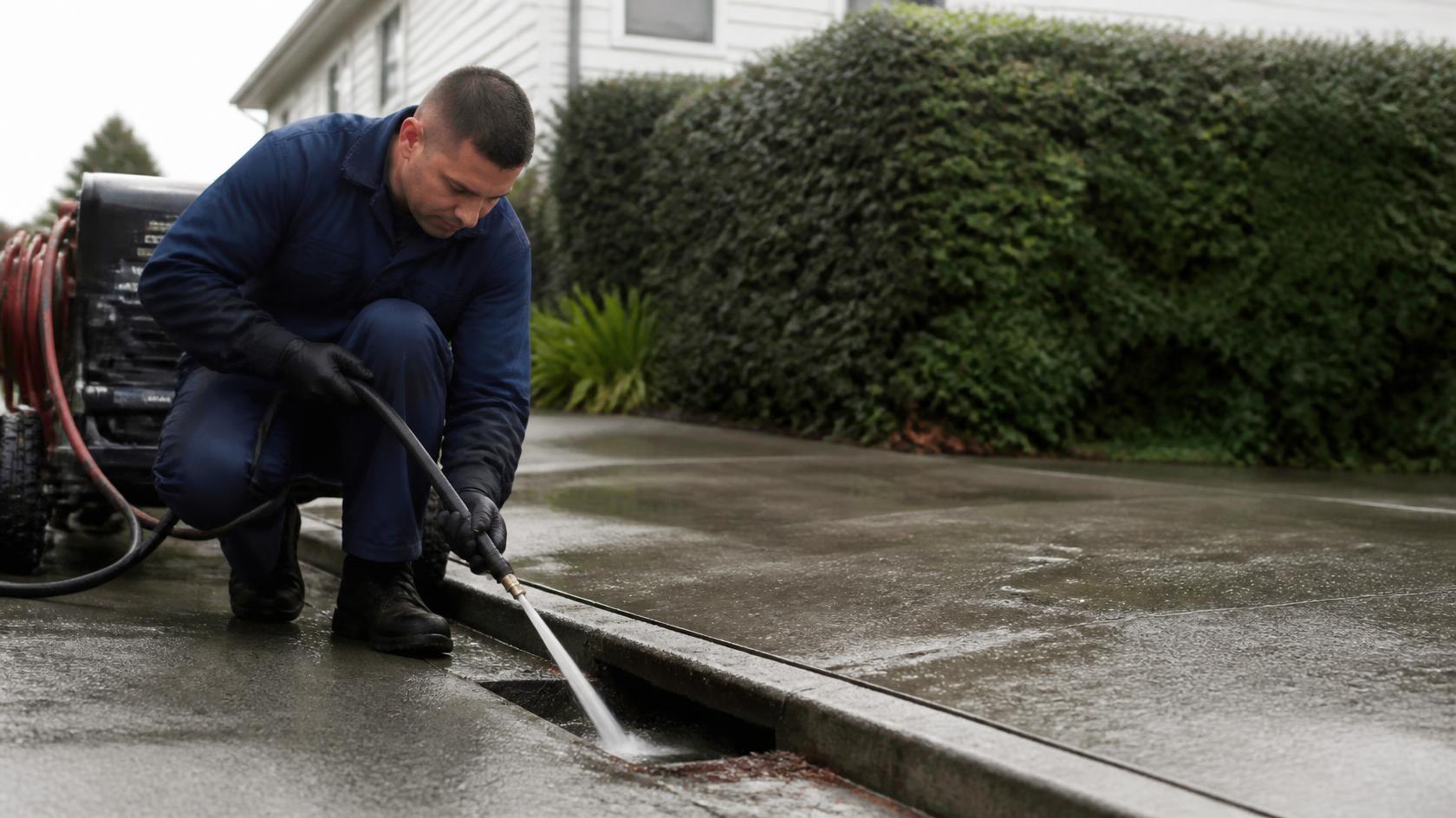
Rods for a single obstruction near an access point. A jetter for silt, leaves and fine roots, because it scours the full pipe rather than punching a hole through the blockage.

Camera it if it keeps blocking

A camera run through the line shows roots, cracks, sags and collapsed sections, and where they are, so a repeat blockage gets a cause rather than another clearing.

Fix the cause

A missing grate, a root-damaged joint, a broken section or stormwater going where it should not. You get the footage and a plain explanation of the options.

Cost

What drives the cost of clearing an outside drain

Clearing an outside drain is priced on time and equipment, so the cost depends on what is in the pipe, how far along it the blockage sits and how easy it is to reach. We don't publish set figures because the range is wide. These are the things that move it.

What drives the priceWhy it matters
AccessA sump or rodding eye close to the blockage is quick. No access point, or one buried under paving, adds time.
What is in the pipeLoose leaves come out quickly. Packed silt, set concrete and root masses take longer and usually need the jetter.
Length and depth of the lineA short downpipe connection is a small job. A long run across the section to the boundary is a bigger one.
Rods or jettingRods suit a single blockage. Jetting costs more on the day and keeps a silted line clear for longer.
Whether a camera is neededWorth it on any drain that has blocked before, because it decides whether you are looking at maintenance or a repair.
UrgencyWater heading for the house during a storm is a different callout from a slow sump on a dry week.

You get a range on the phone and a firm price on site before work starts. For how pricing works across every drainage service, see our Auckland blocked drain cost guide.

Outside drains in Auckland conditions

Auckland's outside drains have a seasonal rhythm. Sumps and pipes silt up slowly through a dry summer and then fail in the first heavy rain of autumn, when the water arrives at once with a season's leaves behind it. Clearing spouting, sumps and channel drains before the wet months does more than any callout.

Older suburbs add their own problems. Through the inner isthmus, stormwater lines are often old earthenware or concrete with many joints, and mature street and garden trees put roots into them. Newer subdivisions bring the opposite issue: silt and building waste washed in during construction. On older or fragile pipe, drain jetting is done only after the condition has been checked, preferably with a CCTV drain survey.

Stormwater and outside drains: common questions

What is a stormwater drain cover called?

Usually a grate, and the pit underneath it a sump or catchpit. Long grated channels across a driveway are channel drains. A grate is sized to its frame and made for a load, so a driveway grate has to be rated for vehicles while a garden one does not. If a grate is missing or broken, replace it before debris gets into the pipe.

How do I connect downpipes to my stormwater system?

Through the underground stormwater pipe, never into a gully trap or the wastewater line, which Watercare's bylaw prohibits outside the combined areas. New drains must be laid by an authorised drainlayer, and a new connection to the public stormwater network needs Auckland Council approval. Reconnecting an existing downpipe like for like is a smaller job, but the work still has to meet the Building Code.

What are the rules for stormwater drainage in New Zealand?

The Building Code's clause E1 Surface Water sets the national standard: water from a 10% annual-probability storm that buildings or sitework collect or concentrate must be disposed of without likely damage to other property, water from a 2% storm must stay out of homes, and drains must give reasonable access for clearing. In Auckland, the Stormwater Bylaw 2015 adds rules on connections and requires private systems to be kept in good operating condition.

Can I pave or build over a stormwater drain?

Don't pave over a sump or grate. It still collects water but you lose the access needed to clear it, which the Building Code expects drains to have. Building over a pipe is a bigger question: public stormwater pipes can run through private land, so check the council's GeoMaps viewer and ask Auckland Council before you plan any building work near one.

Where does Auckland's stormwater go?

Mostly to streams, harbours and the sea, through public pipes, catchpits, ponds and outfalls managed by Auckland Council's Healthy Waters department. Some properties dispose of it to the ground through soakage pits instead. Because much of it is not treated like wastewater, anything poured into a stormwater drain, from paint wash to drain cleaner, can end up in a waterway.

What kinds of pipe are used for stormwater?

On newer Auckland houses stormwater pipe is usually PVC, with fewer joints for roots to find. Older properties often have earthenware or concrete pipe with many joints, which is where roots get in and sections crack or sag. The material matters when a drain is cleared, because fragile older pipe should be checked before it is jetted.

Stormwater drain clearing across Auckland

We cover the whole region. Pick your suburb for local detail.

Other drainage services

Need a stormwater or outside drain cleared?

Tell us what the drain is doing. We will tell you whether this is the service you need, and what it should cost.

Call nowFree estimate