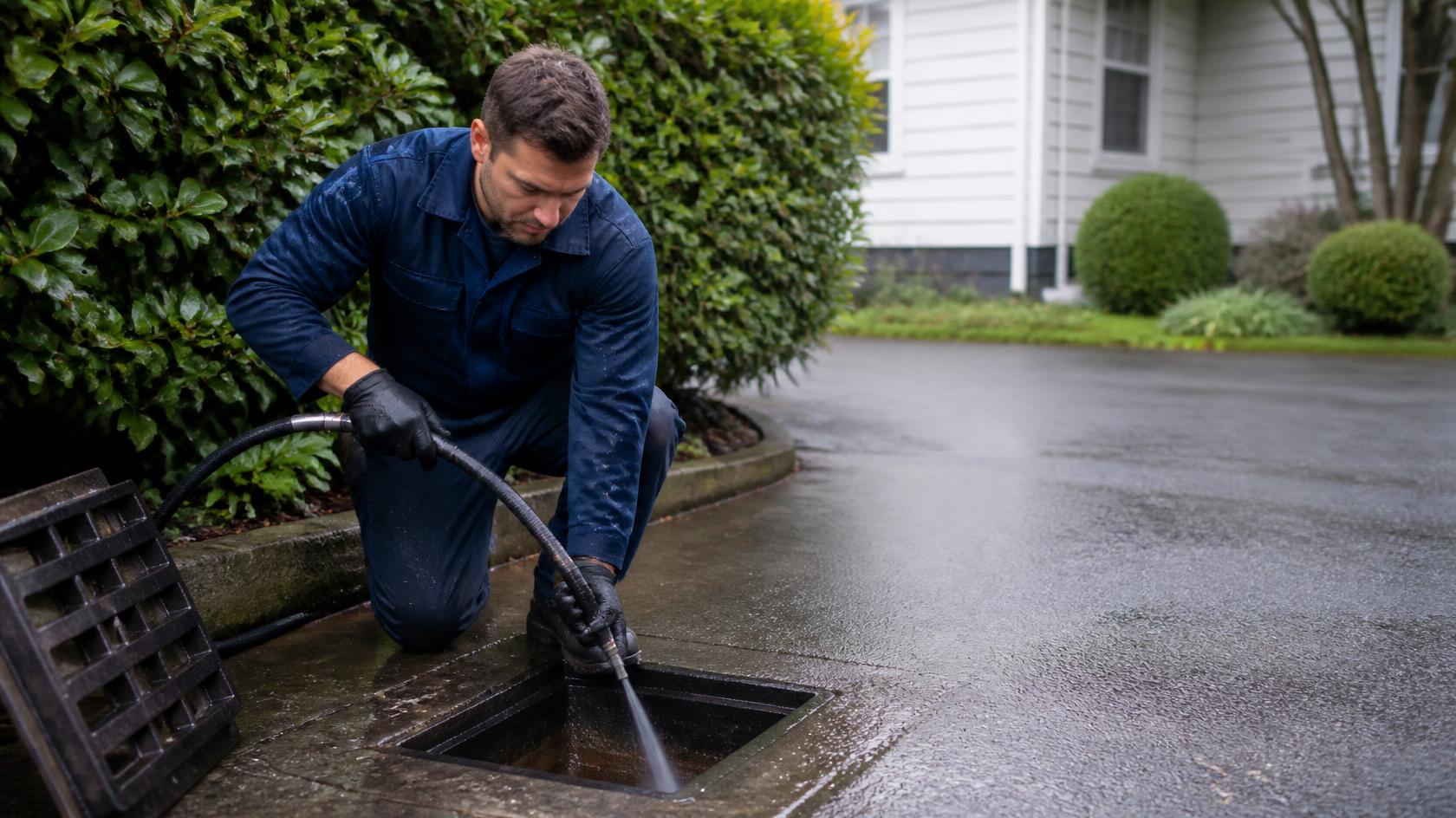
See the actual problem
CCTV Drain Surveys Auckland
A camera down the line turns guesswork into evidence. You get to see what is in your drain, how far along it is, and whether it needs fixing.
See the actual problem
A camera down the line turns guesswork into evidence. You get to see what is in your drain, how far along it is, and whether it needs fixing.
A CCTV drain survey sends a waterproof camera on a flexible rod or crawler along the inside of a drain, recording the pipe's condition and pinpointing faults. It identifies root intrusion, cracks, displaced or dropped joints, collapses, blockages and incorrectly connected pipes, and a sonde in the camera head lets the fault be located and depth-marked from the surface. It is the only way to know the cause of a recurring blockage without excavating, and it is what any honest drain repair quote should be based on.
Underground drainage is invisible. Without a camera, a diagnosis is inference from symptoms — sometimes a good inference, but still a guess. And the cost of guessing wrong runs in one direction: you either dig up a driveway that did not need digging, or you keep paying to clear a drain that was never going to stay clear.
A survey converts that into something you can act on. You see the root mass at 8.4 metres. You see the crack it came through. You see that the rest of the line is sound, which means a short relined section rather than a full replacement.
This is not a courtesy. If you are a landlord justifying a repair to an owner, a buyer deciding whether to proceed, an owner getting a second quote, or someone dealing with an insurer or a neighbour over a shared drain, the recording is the evidence. It is yours, and we would be suspicious of anyone who inspected your drain and would not hand it over.
When it applies
Not every blocked drain needs a camera. These are the situations where it pays for itself, and we will tell you when you are not in one of them.
The single clearest case. If you have paid to clear the same drain twice, a survey costs less than the third clear and actually answers the question.
A repair quote without a survey behind it is an estimate dressed up as a price. You cannot sensibly cost an excavation without knowing depth, location and how much of the line has failed.
Building inspections generally do not cover underground drainage. On an older Auckland property with mature trees, a lateral full of roots is exactly the kind of problem that is invisible until after settlement.
Relining suits pipe that is cracked or leaking but structurally continuous. A collapsed or badly deformed section usually needs excavation. Only a camera tells you which you have.
Where one private drain serves several properties, footage showing exactly where the fault sits — and on whose land — turns an argument into a fact.
A post-repair or post-jetting survey confirms the line is genuinely clear and the repair sits correctly, rather than taking it on trust.
How it runs
We work from the gully trap or an inspection point. Where the line is heavily blocked, it usually has to be cleared first — a camera cannot see through a solid obstruction.
A waterproof head on a flexible rod, or a crawler unit for larger diameters, travels the line while we watch the screen. Distance is measured continuously so every fault has a position.
A sonde in the camera head transmits to a locator above ground, so a fault can be pinpointed on the surface and its depth recorded. That is what makes a targeted repair possible instead of exploratory digging.
We walk you through what is on screen in plain language, and you get the footage and stills along with a clear view on whether this needs fixing now, later, or not at all.
Cost
| What drives the price | Why it matters |
|---|---|
| Length and complexity of the line | A single short lateral is quick. A property with several branches, multiple access points and a long run to the boundary takes longer. |
| Whether the drain needs clearing first | A camera cannot see through a solid blockage. If the line is fully blocked, clearing has to happen before surveying, and that is a separate piece of work. |
| Access | An accessible gully trap or inspection chamber is straightforward. Where no access point exists, one may have to be created, which changes the job. |
| Locating and depth-marking | Simple viewing is one thing. Sonde-locating a fault, marking it on the surface and recording depths for an excavation quote takes additional time. |
| Reporting | A verbal walkthrough plus footage is standard. A formal written condition report for an insurer, solicitor or body corporate is more involved. |
A survey is not always necessary, and we would rather talk you out of one you do not need than sell it. For a first-time blockage with no history, clearing the drain is usually the whole job. The survey earns its keep when there is a pattern, a decision to make, or real money about to be spent.
For realistic dollar ranges across every drainage service, see our Auckland blocked drain cost guide. We give you a price before work starts, never after.
A CCTV drain inspection costs more than a simple drain clear. It needs specialist camera equipment and more time on site, and the drain often has to be cleared or jetted first so the camera can see the pipe wall. It costs far less than digging up a drain that did not need digging, which is the point of doing it.
We give you the price before the camera goes in, not after.
Three things set the price of a drain camera inspection more than anything else:
Tell us what the survey is for when you call, and the price will reflect it.
We run CCTV drain inspections across the whole Auckland region from the van, so we come to the property. You see the footage on site and it is yours to keep, whether you are a homeowner deciding on a repair, a landlord justifying one, or a buyer checking a house before you commit. If you are buying, our pre-purchase drain inspection guide covers what to look for, and CCTV drain surveys explained walks through what the camera can and cannot tell you.
The problems a sewer drain camera inspection finds most often are tree root intrusion at joints, displaced or open joints, sags where a section has dropped and holds water, cracked or broken pipe, partial collapse, fat build-up and the odd foreign object. Across Auckland the suburb is often a decent predictor of which of these the camera will show, because pipe age and soil type drive most of the pipe damage in a private sewer line.
In the older central suburbs — Ponsonby, Mt Eden, Epsom, Remuera, Newmarket — we are usually looking at glazed earthenware laid in short jointed lengths. The characteristic finding is a fine root curtain hanging at a joint, sometimes several joints in a row, with the pipe barrel itself still sound. That is close to the ideal relining candidate: the structure is there, the seals have failed.
On the North Shore and through West Auckland, ground movement in heavy clay soils shows up as displaced joints and dips — steps where one section has dropped below the next, with standing water sitting in the low point and solids accumulating there every time the drain is used.
In newer subdivisions such as Botany Downs and much of Albany, the pipe is generally sound uPVC and the finding is nearly always contents rather than structure: fat, wipes, or occasionally construction debris left in the line during the build.
One finding worth flagging because it surprises people: stormwater wrongly connected into the wastewater line. It looks harmless until heavy rain, when roof water overwhelms a drain never sized for it. Wastewater and stormwater are separate networks in Auckland, run by Watercare and Auckland Council's Healthy Waters respectively, and cross-connections are a genuine problem — both for your drain and for the network.
Generally the full private lateral from the access point out to the boundary connection, assuming the line is clear enough for the camera to travel. Sharp bends, partial collapses and heavy blockages can stop the camera early — which is itself a useful finding, because it locates the problem.
For a meaningful survey, yes. A camera cannot see through a solid blockage or a pipe full of standing wastewater. Where a drain is fully blocked, it is normally cleared first and then surveyed, often in the same visit.
Yes, always. Video and stills are yours to keep. If you need a formal written condition report for an insurer, solicitor, body corporate or property manager, we can produce one.
Yes. The camera head carries a sonde that transmits to a locator above ground, so we can mark the position on the surface and record the depth. That is what makes a targeted repair possible rather than exploratory excavation.
On an older Auckland property with mature trees, it is one of the better-value pre-purchase checks available. Standard building inspections do not generally include underground drainage, so root intrusion or a collapsed section stays invisible until it becomes your problem.
That is one of its main uses. Relining needs a pipe that is cracked or leaking but still structurally continuous and reasonably round. A collapsed, crushed or severely deformed section usually has to be excavated. The footage is what makes that call, and it should come before any repair quote.
Yes, private stormwater lines, sumps and downpipe connections on your property. Public stormwater pipes and street catchpits belong to Auckland Council rather than the property owner.
We cover the whole region. Pick your suburb for local detail.
Tell us what the drain is doing. We will tell you whether this is the service you need, and what it should cost.