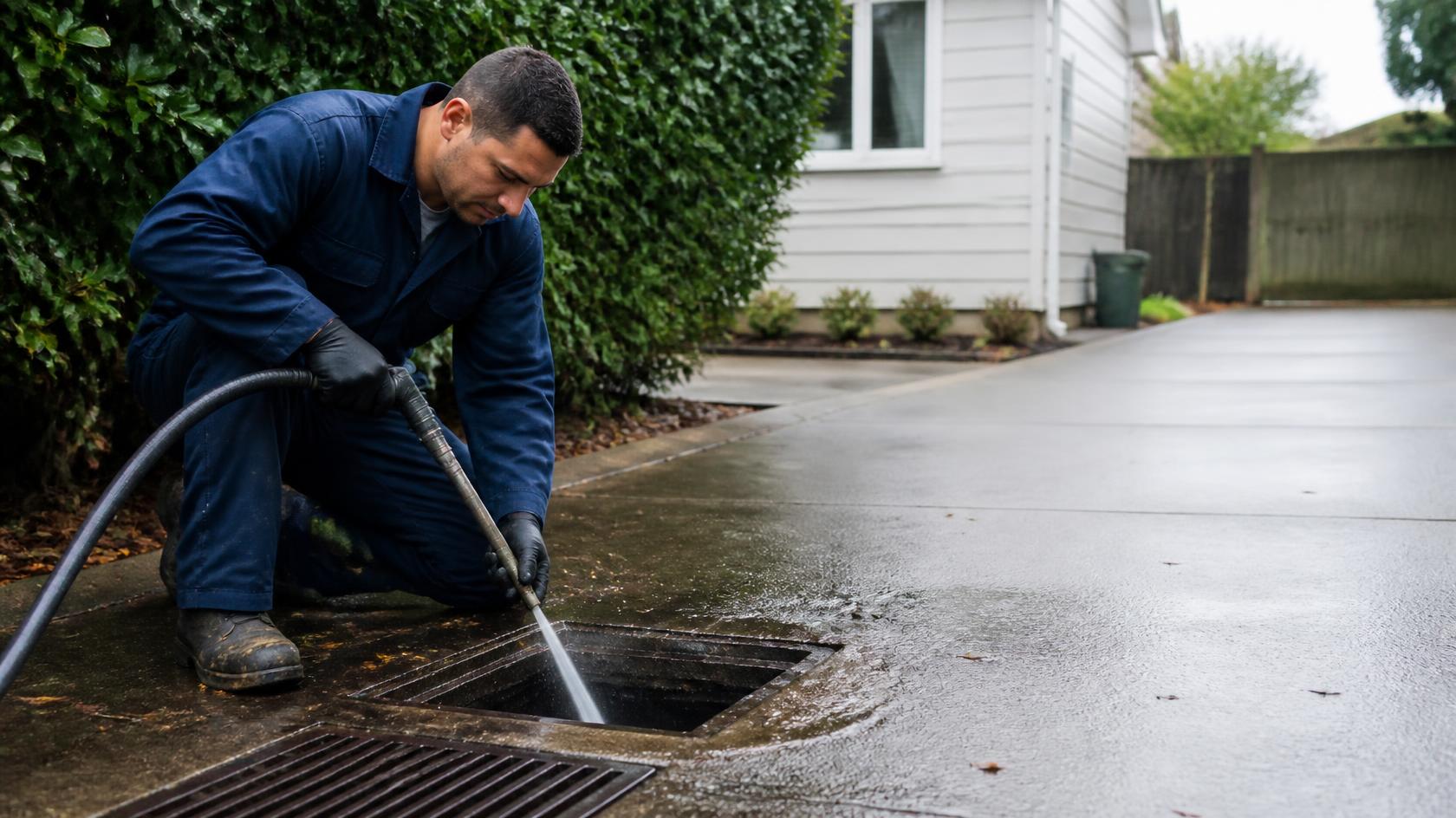
Blocked Drains Auckland arranges licensed, certifying drainlayers across the whole Auckland region. When a drain needs more than clearing, when it has to be repaired, relined or altered, the work is done or supervised by people licensed to do it. That matters, because in New Zealand, drainlaying is restricted work.
We are a mobile service, so the van comes to your property, and you agree the price before any work starts.
A drainlayer works on the pipes that carry wastewater and stormwater away from a property. On most Auckland properties, that is the private lateral running from the house to the connection with the public network, plus the stormwater drains across the section.
The drainlayer work we do includes:
Every repair starts with a camera, so you are paying to fix the fault that is actually there.
Drainlayers also lay new drains: for an extension or a new bathroom, a minor dwelling, or the connections across a subdivision. New drainage is building work that normally needs a building consent, and a new connection to the public wastewater or stormwater network needs approval from Watercare or Auckland Council first. The drainlayer should tell you which consents and approvals apply before giving you a price.
Clearing a blocked drain does not need a licence. Installing, altering or repairing a drain does. It is restricted work under New Zealand law, and it has to be carried out or supervised by a licensed drainlayer.
Plumbing and drainlaying are separate licences. A plumber is not automatically licensed to repair a drain, so it is worth asking before work starts. You are entitled to ask any drainlayer for their licence card, and to check it on the Board’s register (below).
Unlicensed drain work can cause problems later: with the council, with insurers, and when you come to sell.
Search the public register run by the Plumbers, Gasfitters, and Drainlayers Board. You can search by name, company, town or postcode. The register shows each person’s registration and licence, any conditions on it, whether they work under supervision, and any disciplinary decisions from the last three years. Ask for the name of whoever is doing or supervising the work before it starts, and check it.
One change worth knowing about: from 7 September 2026 the Board began taking applications from certifying drainlayers for a self-certification endorsement, which lets an endorsed drainlayer sign off their own consented work. If someone offers to certify their own work, the register should show that endorsement.
Auckland's drains fail in predictable ways, and a good drainlayer knows what to expect under a particular kind of house.
Underneath all of it, much of Auckland sits on clay that swells when wet and shrinks when dry. Over decades that movement pulls jointed pipe out of line, which is why so many older drains end up with sags and steps that hold water.
In Auckland, start with the property file. You order it online from Auckland Council, and it holds the building consents, plans and correspondence the council has for the address, which usually includes any drainage plans lodged with past consents. A standard file takes up to 10 working days and an urgent one up to three. Older homes may have little on file, and what is there does not always match what is in the ground.
Where can you get a drainage plan if the file has none, or you need to be sure? A drainlayer can trace the line with a camera and a locator, then mark its route and depth from the surface. That is worth doing before you build a deck, an extension or a retaining wall near the drain, because building over or close to a drain has its own rules.
There is no honest per-metre price for drainage in New Zealand, because metres are rarely what drives the bill. Depth, ground conditions, what has to be dug through and put back, pipe size, and the number of junctions and access points decide it. A shallow run across a lawn and the same length under a concrete driveway can differ several times over. A drainlayer prices from the survey and the site, not a rate card.
For clearing rather than drainlaying, the typical costs for drain unblocking services in Auckland are set out in our blocked drain cost guide, along with the ranges local businesses publish.
Natural runoff, yes. Auckland Council’s guidance is that you have to accept stormwater that naturally flows onto your property from higher ground. Collected or concentrated water is different: the Building Code requires surface water collected by buildings or sitework to be disposed of without damage or nuisance to other property. A downpipe or new paving that now dumps water on your section may fall into that category.
Talk to your neighbour first. If that does not resolve it, it is generally a civil matter between neighbours, so get advice from Auckland Council or a lawyer before spending money. A drainlayer can show on camera where a pipe actually discharges, which helps either way.
No. In Auckland, Watercare’s Water Supply and Wastewater Network Bylaw says no one may cause or allow stormwater to enter the wastewater network or any private drain connected to it. The exceptions are narrow, such as older combined-sewer areas where the council has approved it. Downpipes, yard sumps and driveway drains belong on the stormwater system. Property owners are responsible for keeping their own stormwater out of the wastewater.
It matters because roof water can overwhelm a wastewater line in heavy rain and cause overflows, at your gully and further down the network. Wrong connections are usually old alterations, and a CCTV drain survey or a simple dye test finds them. Separating them is drainlaying work.
Before any drainlayer starts work, it is worth being sure the fault is on your side. Everything from your fixtures to the public connection is the property owner's. The public wastewater main is Watercare's, and they fix it at no charge. If we find the fault is on the public side, we tell you, and you pay us nothing. Our guide to who is responsible for a blocked drain explains where the line sits.
We cover the North Shore, West, Central, East and South Auckland. There is a page for each suburb we cover on our service areas page.
Call 09 925 0448 to talk to a drainlayer, or request a free estimate.